
Lead pipes: how to tell if you have them
You can often tell whether you have lead pipes with just a coin or key and a fridge magnet, checked right where the water pipe comes into your home. Lead pipes are more likely in older cities and in homes built before 1986. If your building is that old, the check is worth a few minutes, even if your water looks and tastes fine (EPA).
- 1961: the last year plumbers in NYC could legally put in new lead service lines
- NYC's free water test kit: one per household, results mailed to you within 30 days
- Hiring your own plumber for a service line swap: can be more than $8,000
- If DEP sends you a letter, the city replaces your line free, in roughly one to two days of labor
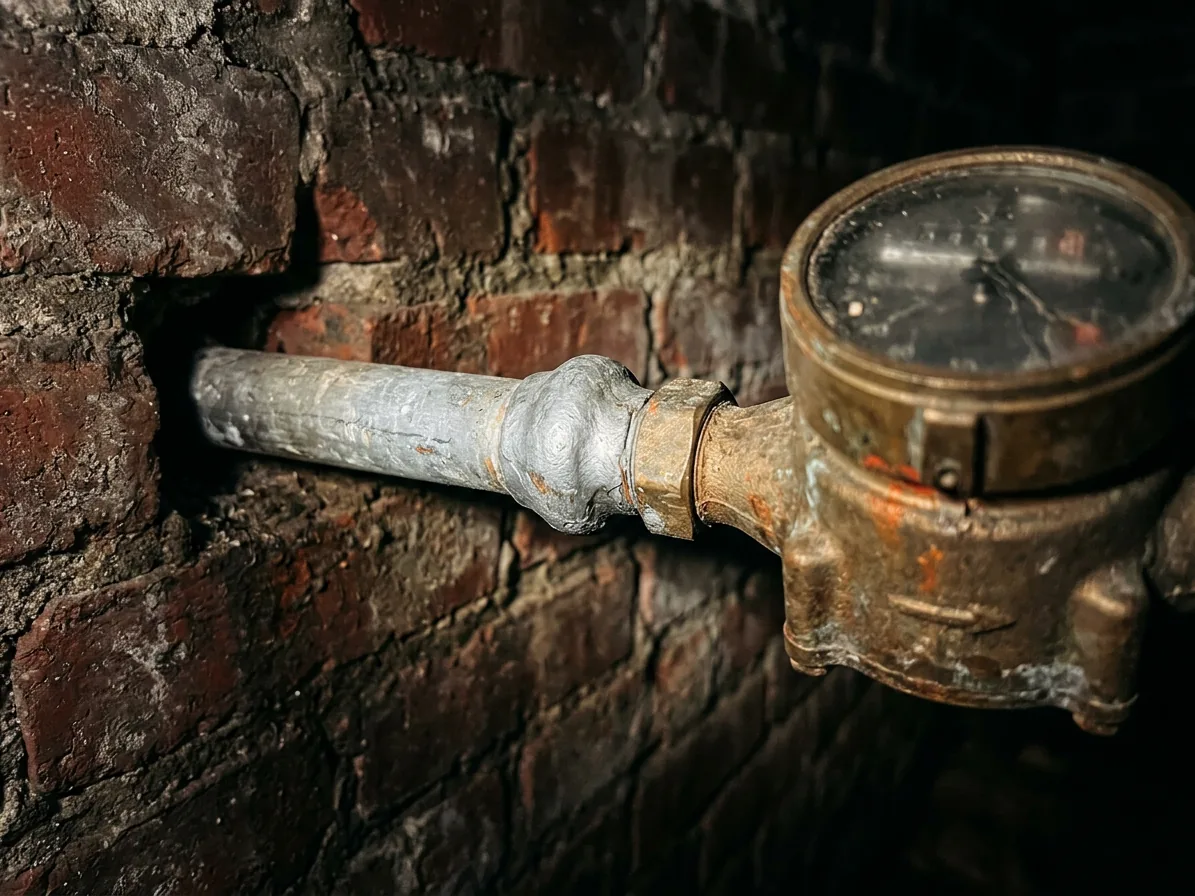
The scratch-and-magnet check for lead pipes
The pipe to check is called the service line. It's the one pipe that runs from the water main under the street into your building, usually entering through a basement wall or floor.
- Go to where the service line comes through the wall or floor and check a spot near that entry (EPA guide).
- Rub the pipe lightly with a coin or key. You just want to get past the dull outer layer, not scrape deep.
- Check the color where you scratched. Lead comes up shiny silver; copper looks like a penny.
- Touch a magnet to the pipe. Lead won't hold a magnet, but galvanized steel will.
| What you notice | Magnet | Likely pipe |
|---|---|---|
| Shiny silver scratch | Won't cling | Lead |
| Scratch the color of a penny | Won't cling | Copper |
| Magnet sticks to the pipe | Clings | Galvanized steel |
If you're still unsure, don't guess. A water test shows what's really coming out of your tap, no matter which metal your pipe is.
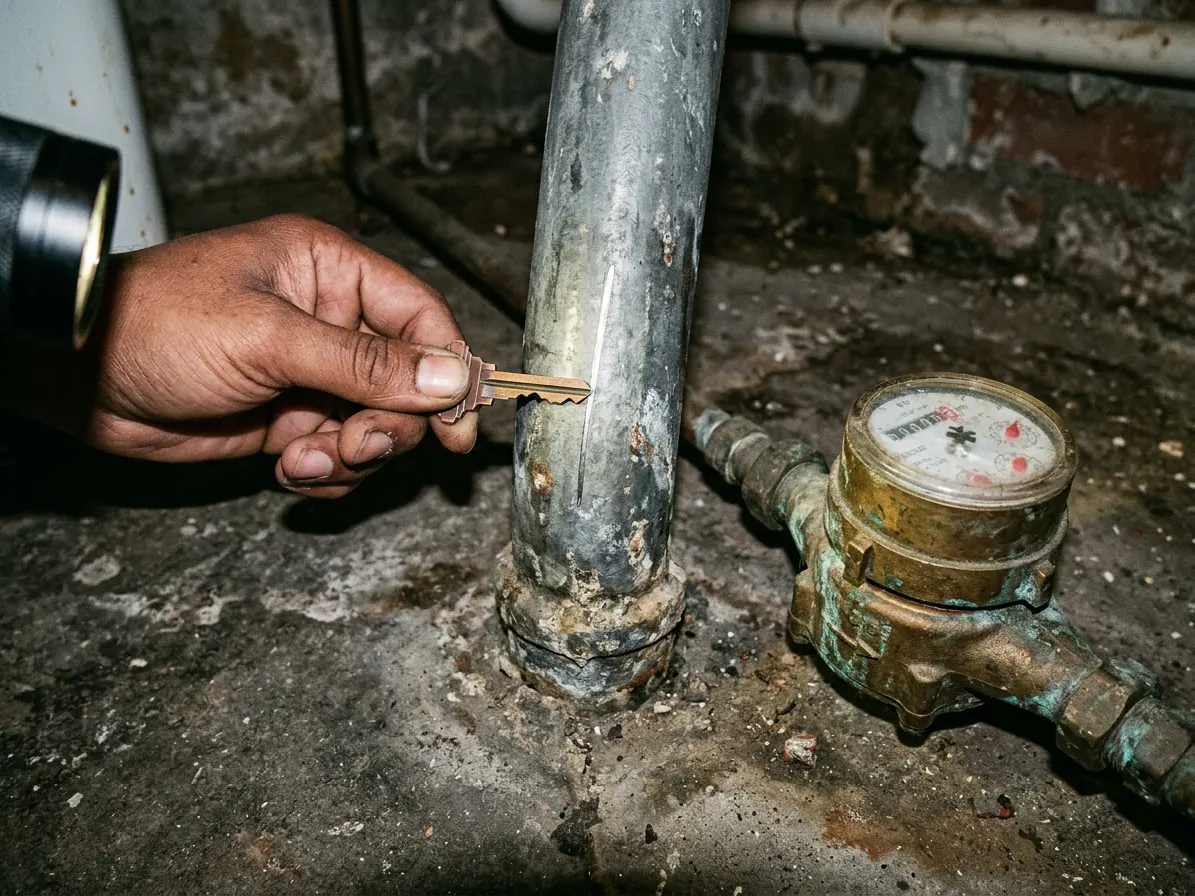
What a lead pipe looks like after the scratch test
Lead is soft. A light scratch with a key leaves a bright silver line on a dull grey pipe, and a magnet slides off. Copper shows a penny color. If you are not sure, call your water utility and ask what their service line inventory shows for your address.
Who owns the service line, and who pays for a new one?
In New York City, the service line belongs to the property owner in its entirety (NYC DEP). Some owners qualify for free replacement through the city's program.
Lead service lines were still legal in NYC until 1961, when new ones were banned (NYC DEP). In 2023, the NYC Coalition to End Lead Poisoning estimated that about 1 in 5 New Yorkers may get their water through a pipe made of lead, or one that might be lead (NYLCV).
Hiring a plumber to swap out a service line can run past $8,000. DEP, the city's water department, replaces eligible lead and galvanized lines with copper for free. You qualify only if DEP has sent you a letter or the city's Department of Design and Construction has contacted you. The work itself runs roughly one to two days (NYC DEP).
A federal rule from October 2024 gives water systems 10 years to find and replace lead pipes (EPA). NYC's plan targets the EPA's 2027 deadline under this rule, and the federal Bipartisan Infrastructure Law set aside $15 billion for replacing lead service lines (NYC DEP).
Where the lead in your water comes from
By the time NYC water reaches your street, it carries no lead. Anything in your glass was picked up in plumbing on the property (NYC DEP). That lead slips in as lead-containing plumbing slowly wears away, letting tiny amounts of metal end up in the water (EPA).
A lead service line is usually the most significant source. Even homes without one can have lead, most often from brass or chrome-plated brass faucets, or from lead solder (EPA).
"Lead-free" doesn't mean completely free of lead. The legal limit is a weighted average of 0.25% across surfaces that touch water, and 0.2% for solder and flux, the materials used to join pipes (EPA).
Can any level of lead in drinking water be safe?
EPA's health goal for lead in drinking water is zero (EPA). Water systems get measured against a different figure, the action level. The action level is triggered when more than 10% of tap samples exceed 15 parts per billion; it is not a safety threshold for your tap water.
Water can account for 20% or more of a person's lead exposure. For babies drinking formula, that can reach 40 to 60% (EPA). Even at low levels, lead in children is tied to learning disabilities, shorter height, and impaired hearing (EPA).
How to get a free lead water test in NYC
NYC gives lead test kits away at no charge, one to each household, and you can order one by calling 311 or filling out the city's online form. You get results by mail within 30 days (NYC DEP).
Going through a private lab instead of the city program generally costs $20 to $100 (EPA). Even with copper pipe at the wall, lead solder or a brass faucet could still add lead.
Safe water habits while you wait for a new pipe
Keep all drinking, cooking, and baby-formula water cold from the tap. If you need it warm, heat cold water on the stove, but keep in mind that boiling won't remove lead (EPA).
Flush your pipes before you drink. Whether you run the tap, shower, or wash clothes and dishes, it all counts as flushing (EPA). NYC's health department recommends running the water for at least 30 seconds, until it feels clearly colder (NYC Health). If you know your plumbing has lead, the Mayo Clinic recommends at least 1 minute of cold water first (Mayo Clinic).
If you choose a filter, look for one certified to remove lead (EPA).
Showers and baths are fine even with lead pipes, since your skin won't absorb lead from water (EPA). The cold-water and flushing tips are about the water you drink and cook with.