
Lead poisoning test: how children are tested for lead
A lead poisoning test uses a blood sample. Your child gives a little blood, the lab looks for lead in it, and you get a number back. Every child in New York gets tested at 1 and 2 years old, and each year after that the doctor should check for lead risk until your child's sixth birthday.
- the ages New York tests every child
- Ages 1 and 2
- lead risk check by the doctor
- Yearly to 6
- CDC reference value
- 3.5 µg/dL
When does New York test children?
Doctors in New York State must test every child at ages 1 and 2. It does not matter whether anyone believes the child has been around lead. After age 2, your doctor should ask about lead exposure each year up to age 6 and order a new test when there is a reason, as the NYC Health Department explains.
For children on Medicaid, testing happens at 12 months and once more at 24 months. A child on Medicaid who is between 24 and 72 months old with no test on record should also be tested, following the CDC's guidance on testing.
If you are expecting, your first prenatal visit should include questions about lead exposure. This check matters because lead already inside a parent can pass along to the baby, and the NYC guidance covers that visit too.
What is a blood lead test?
This test shows how much lead is in the blood. Results come in micrograms per deciliter, a very small weight of lead in a drop of blood. On the lab report you will usually see µg/dL.
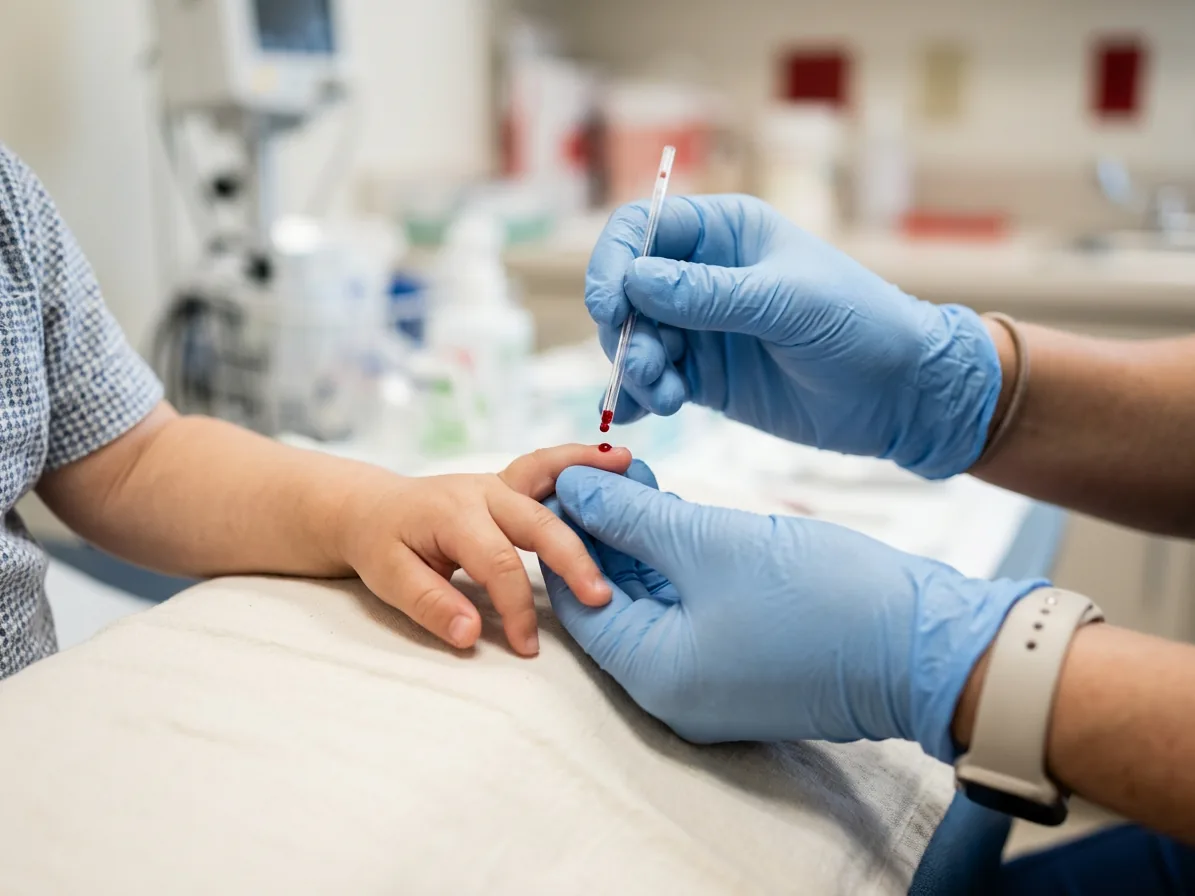
There are 2 ways to collect the blood. A capillary sample comes from a fast prick of the finger, or of the heel for a baby. A venous sample uses a needle to draw blood from a vein in the arm, like most blood tests, as the CDC's clinical guidance describes.
Many doctors begin with the finger-prick since it is quick and less of a bother for a small child. The catch: lead dust left on the skin can get into that drop of blood and push the number higher than it really is. That means a high finger-prick number is not the final answer, the CDC notes.
Confirming a finger-prick result
A finger-prick result of 3.5 micrograms per deciliter or more should be confirmed with a venous sample from the arm. Dust on the fingers does not affect the arm sample, so this one shows the true number.
How quickly the second test happens depends on how high the first number was. The CDC says to confirm it sooner when the result is higher.
| Finger-prick number (µg/dL) | Arm sample to confirm within |
|---|---|
| 3.5–9 | 3 months |
| 10–19 | 1 month |
| 20–44 | 2 weeks |
If the finger-prick comes back under 3.5, no second sample is needed. The next routine test at the scheduled age will cover it, and the doctor can always order one sooner if a new concern comes up.
Understanding your child's lead test result
The key number is 3.5 micrograms per deciliter. The CDC's name for it is the blood lead reference value. It marks the point where doctors and health departments begin to act. The CDC sets it, and the EPA uses it too.
This number is a yardstick, not a green light for safety. It works by comparing your child with other children. The CDC picked it by looking at national health surveys from 2015 to 2018, which found that only 2.5% of American children between their first and fifth birthdays carry that much lead, the CDC reports. A result of 3.5 or above means your child carries more lead than 97.5% of children the same age.
That is still a lot of children. Roughly 500,000 children nationwide have a level of 3.5 or above, the CDC says. If your child is among them, you are not alone, and clear steps come next.
What if the level is high?
When an arm sample confirms 3.5 or more, your child's doctor works through a set of steps that grow stronger as the number climbs. The CDC's provider steps lay this out.
With a confirmed level between 3.5 and 19, the doctor sends the result to the state or local health department. The doctor will also sit down with you about lead, where your child plays and what little hands may have touched, and set up someone to track down the source. On its own, a number under 5 might not be strong enough to set off a housing investigation under federal housing rules.
Between 20 and 44, the doctor goes over your child's full history and does a physical exam, the home or other places get looked at, and an X-ray of the belly may be ordered to check whether your child has swallowed something with lead in it, like a paint chip.
From 45 up, the CDC's strongest response kicks in. That means a check of the brain and nerves (a neurological exam), a belly X-ray, and sometimes a stay in the hospital. Any child this sick, confused, weak, vomiting, in belly pain, or having seizures, needs to be in the hospital.
Chelation is a medicine that pulls lead out of the body. Doctors turn to it only in the most serious cases, so nearly all children above 3.5 will go without it.
Why test a child who seems well?
Most children with lead in their blood show no clear signs of it, the CDC explains. The NYC Health Department puts it simply: a person with lead poisoning usually looks and feels perfectly healthy.
This is exactly why New York requires the test at ages 1 and 2 for all children, not just the ones who seem sick. The blood test is usually the only way to find out, and once a number of 3.5 or higher comes back, the investigation and follow-up begin.