
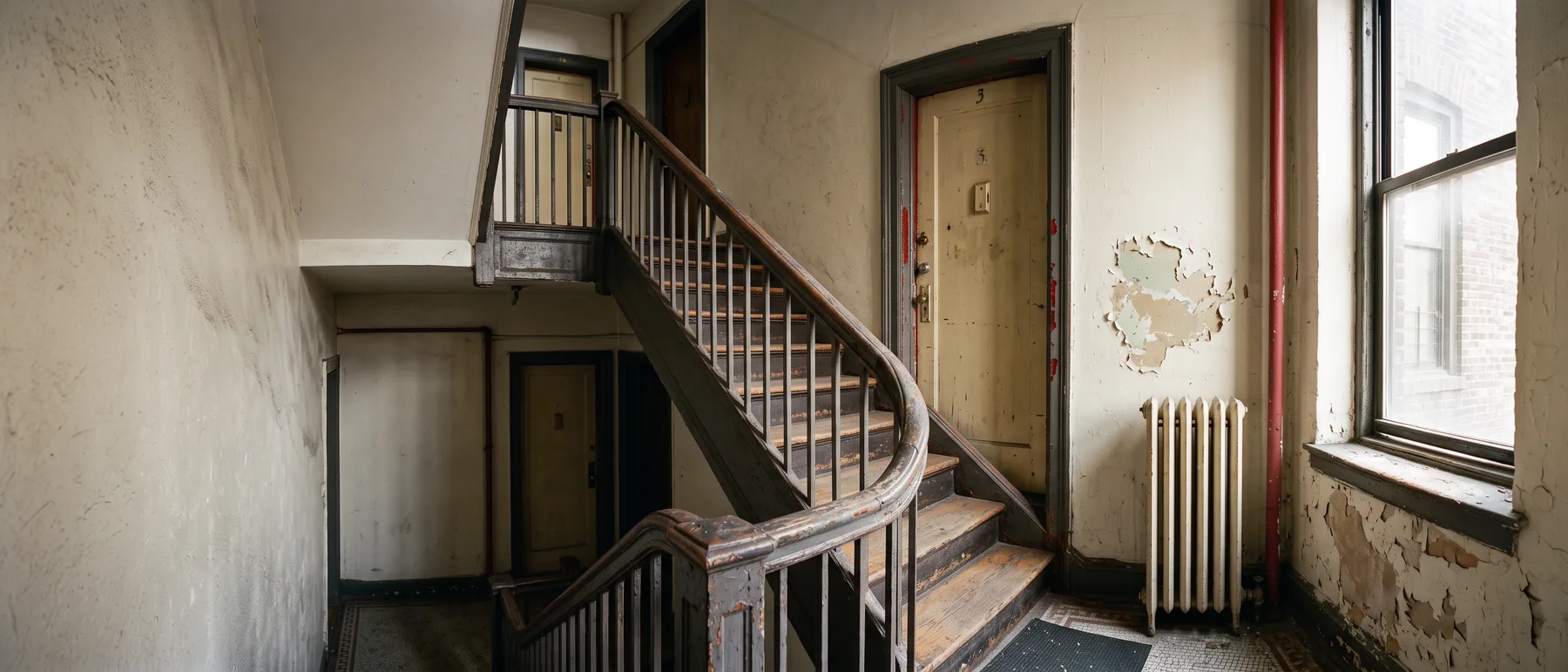
NYC lead paint law: Local Law 1 and HPD lead violations
New York City presumes the paint in buildings built before 1960 contains lead. Here is what the landlord must do, and how HPD enforces it.
Check a building's lead record
Pick the borough if you know it. No lot or building number needed.
Local Law 1, the city's own lead paint rule, makes your landlord track down and repair peeling lead paint in your unit whenever a young child lives there or spends time there. It took effect on August 2, 2004. Today 15,974 buildings citywide have an open lead paint violation on record.
Local Law 1 at a glance
- 15,974
- NYC buildings with open lead paint violations
- Before 1960
- buildings presumed to have lead paint
- Under 6
- children the law protects, including visits of 10 or more hours a week
- Every vacancy
- door and window lead work before the next tenant moves in
92,446 open lead violations citywide, 89% of them class C. Open means HPD has not yet accepted the repair.
Your next steps
- Keep children away from peeling paint. Wash hands, toys, pacifiers, window sills and floors often, and keep children away from rooms where repair work makes dust. Don't sand, scrape or repaint old paint yourself, because that creates lead dust.
- Get your child tested. If you think your child was exposed, get a blood lead test from the doctor now. At age 1, and once more at age 2, New York also requires the test. How the test works
- Put your complaint in writing. Tell your landlord about the peeling paint, and whether a child under age 6 lives there. Free letters in English and Spanish
- Report the problem to HPD. Call 311, or report it online, about peeling paint or repair work that makes dust. Filing is free, and your immigration status doesn't matter.
- Child tested high for lead? Follow the doctor's plan for retesting, then talk to a lead paint lawyer about the building's record: call (888) 503-5930.
Which homes the law covers
Over half of the city's housing stock went up before 1960, when lead paint was banned, so your building may well be included. Any building put up before 1960 falls under the law. Buildings put up between 1960 and 1978 are covered too, as long as the owner knows lead paint is present.
Within those buildings, the law reaches:
- units in buildings with 3 or more apartments
- rented units in single- and two-family homes
- co-op and condo units that aren't lived in by the owner or the owner's relatives
A lot of the obligations kick in once a child under 6 is living in the unit. A child qualifies if they spend 10 or more hours a week there week after week, so a grandchild you watch often can count. If you aren't sure, HPD's Lead Information Line, 212-863-5501, can help, and you can check your own building's lead violations with the lookup on this page.
What your landlord has to do
An owner's obligations run on a yearly schedule, and a few begin whenever a unit changes tenants. Each January, your landlord must give you the Annual Notice, a short form that asks whether a child under 6 lives with you. The duties and their deadlines, as HPD (the city's housing agency) lists them, are in the table.
| When | What the landlord must do |
|---|---|
| Jan. 1–16 | Give you the Annual Notice, in English and Spanish, with 2 copies of each |
| By Feb. 15 | Collect the completed form (tenants are asked to return it by Feb. 16) |
| Feb. 16 – Mar. 1 | With no form returned, attempt an inspection; failing that, notify the Health Department in writing |
| Yearly, at minimum | Look for peeling paint in any unit where a child under 6 lives |
| Between tenants | Clear lead paint from doors and windows ahead of the next occupant |
| Child under 6 in place on Jan. 1, 2025 | Finish the doors and windows no later than July 1, 2027 |
| Child under 6 arrives afterward | Get that work done inside 3 years |
| At lease signing and renewal | Hand over a lead notice plus the pamphlet "Lead Paint Hazards in the Home" |
Whenever a fix in a child's home disturbs lead paint, or paint that hasn't been tested, across an area larger than 2 square feet, safe work practices are required. Owners have to keep records of all that work for at least 10 years. If your landlord skipped any of this, call for a free case review. It takes a few minutes, and you will know where you stand.
Lead paint violation classes, deadlines and fines
HPD assigns every violation a class based on how risky it is. The worst rating, class C, means the hazard is immediate. Out of the 92,446 open lead violations citywide, 82,412 carry a class C rating, which is 89%.
| Class | How serious | Deadline to fix |
|---|---|---|
| A | Not dangerous | 90 days |
| B | Dangerous | 30 days |
| C, lead paint | Danger is immediate | 21 days |
| Most other class C | Danger is immediate | 24 hours |
An EPA-licensed firm has to do the repair using safe work practices. Afterward, a New York State certified lab checks the dust samples, and only after HPD reinspects can the violation close. Most other violations wrap up 70 days after the owner reports finishing. Lead violations don't work that way.
For a class C lead paint hazard violation, the civil penalty is $250 a day, up to $10,000; other lead orders can carry different penalties. Lying about a completed fix costs $500 to $1,000 each time. If the owner fails to act on a violation, HPD must attempt an emergency repair and bill the property for the cost. If your child's home has an open lead violation, call today for a free case review.
Lead violations still open, by borough
These numbers come straight from HPD's records on NYC Open Data, refreshed monthly. "Open" means HPD hasn't signed off on the repair.
- Brooklyn has 34,528 open lead violations spread across 6,683 buildings.
- The Bronx follows with 32,149 violations in 4,489 buildings.
- Manhattan carries 13,221 violations in 2,152 buildings.
- Queens has 11,754 violations in 2,448 buildings.
- Staten Island rounds it out with 794 violations in 202 buildings.
All told, 26,976 buildings have gotten a lead order at one point or another. Among them, 1,083 carry 10 or more open lead orders dating to January 2023 or later, and every one of those has its own page showing the orders unit by unit.
Recent changes to the rules
The bar for what legally counts as lead paint dropped from 1.0 to 0.5 milligrams per square centimeter on December 1, 2021. Peeling paint now escapes the law only if a test comes back under 0.5.
Local Law 31 of 2020 created a one-time testing requirement as well. By August 9, 2025, owners of pre-1960 buildings had to have each painted surface in every unit and shared space tested once for lead. Stiffer fines under Local Law 71 took effect December 8, 2023, though the $250-a-day lead hazard fine was unchanged.
Reporting peeling paint to 311
If your landlord won't fix peeling paint, or does the work unsafely, you can complain through the city's website or dial 311. HPD inspectors use an XRF machine to test peeling paint.
HPD issues a violation whenever the reading is 0.6 or higher, and also at 0.5, which is treated as inconclusive. Should the first inspector spot peeling paint without an XRF machine on hand, a second one may return to take a reading within 2 weeks. Once HPD writes a violation, keep it with your photos of the peeling paint.
Common questions
Do I have to tell my landlord when a child moves in?
Yes. When a child under 6 begins living in your unit, you must tell the owner. Putting it in writing is smart, since the yearly inspection and the door and window work can't happen until the owner knows.
When does my child need a lead test?
HPD asks parents to remind their doctor to do a lead test at both age 1 and age 2.
Can my landlord ask for extra time to correct a violation?
An owner facing a deadline can request up to 2 postponements from HPD, pushing back the correction date. Even so, the violation remains on record, and the repair, dust testing, and reinspection still have to take place.
Will filing with 311 have any impact on my immigration status?
No. There's no charge to file, and it makes no difference what your immigration status is.